Inner Alignment in Times of AI Dissonance and Resonance: Quantum Leadership Mastery
You are sitting in a strategy meeting. On the table are new AI applications, automation opportunities, and forecasts about how artificial intelligence could transform your business model over the next few years.
At the same time, you sense something that cannot easily be translated into a spreadsheet: an inner tension.
On the one hand, the speed of technological development is fascinating. On the other, it raises questions about control, responsibility, identity, and your own role as a leader. What remains of your experience when machines can analyze increasingly complex situations? Which decisions should remain firmly in human hands? And how do you lead people when even the future of your own organization is becoming increasingly difficult to predict?
This is where a new dimension of leadership begins.
The critical leadership resource of the coming years will not be technological competence alone. It will be the ability to remain internally clear, present, and capable of making decisions even when the external environment is changing at extraordinary speed.
Why AI Is Making Leadership Not Only Faster, but Fundamentally Different
Artificial intelligence is accelerating decision-making, transforming workflows, and redefining what companies can automate. For executives, this means that the pace of external change is increasing while traditional experience and established assumptions may lose some of their reliability.
A managing director could previously rely heavily on industry knowledge, personal experience, and established decision-making models. These capabilities remain valuable. But they are no longer always sufficient when markets, technologies, and customer behavior can change fundamentally within months.
The real challenge is therefore not to understand every new AI application.
The challenge is to develop a clear inner position in an increasingly complex environment.
Imagine a mid-sized company evaluating whether a significant portion of its knowledge work can be supported by AI. The economic arguments clearly favor rapid implementation. At the same time, the leadership team fears losing employee trust, identification, and a sense of purpose.
A purely technological perspective asks:
What can we automate?
A future-oriented leadership perspective asks:
What do we consciously want to preserve? What kind of organization do we want to be? And from which inner position are we making this decision?
This shifts leadership from simply managing external processes toward a more demanding form of self-leadership and organizational leadership.
The faster the external world changes, the more important it becomes to consciously shape your inner alignment.
This development is particularly relevant for executives, entrepreneurs, and business owners. The greater the responsibility, the less decisions can be delegated or reduced to objective data alone.
Leadership always means dealing with uncertainty.
AI Dissonance and AI Resonance: Two States of Modern Leadership
In this context, AI dissonance describes the inner tension that can emerge when the rapid development of artificial intelligence no longer aligns with your own values, assumptions, or established understanding of leadership.
AI dissonance is not a technical malfunction.
It is a human condition.
You may be convinced of the potential of generative AI while simultaneously feeling that the pace of change is overtaking your previous understanding of effective leadership. You may support digital transformation strategically while sensing that decisions are increasingly being influenced by systems whose logic you cannot fully control.
This tension can be paralyzing.
But it can also become valuable information.
Inner dissonance often indicates that something needs to be reassessed and realigned.
AI Dissonance: When Technology Creates Inner Friction
AI dissonance often emerges where external expectations and internal convictions move in different directions.
An executive may experience strong pressure to implement AI as quickly as possible while simultaneously believing that human responsibility must never be delegated to technology.
Another leader may recognize enormous efficiency potential but question whether excessive automation could weaken innovation, organizational culture, or human connection.
The critical question is therefore not:
How can I get rid of this uncertainty as quickly as possible?
A more useful question is:
What is this uncertainty trying to show me about my leadership?
This is where conscious development begins.
AI Resonance: When Leadership Integrates Technology Consciously
AI resonance, by contrast, describes a state in which technological development and inner alignment are brought into greater coherence.
This does not mean approving every technological development.
Nor does it mean becoming blindly enthusiastic about technology.
It means consciously recognizing what a situation requires, understanding which values are non-negotiable, and identifying where new technological possibilities can genuinely create value.
An executive leading from this position does not automatically react to every new AI trend.
They observe, assess, decide, and take responsibility.
The result is a different quality of leadership: less driven by pressure, more grounded in presence; less reactive, more intentional.
Quantum Leadership Mastery: Why Inner Alignment Is Becoming a Leadership Resource
Quantum Leadership Mastery focuses on a dimension that is often less emphasized in traditional leadership programs: the inner state of the leader.
The term “quantum” is not used here as a scientific explanation of leadership. In a leadership context, it can instead point toward the idea that reality is shaped not only by external structures, but also by perception, awareness, relationships, and conscious decisions.
For an executive, this means that your inner attitude is not separate from your leadership.
It influences how you interpret situations, which opportunities you recognize, and which decisions you make.
Consider a typical situation.
Two CEOs receive the same information: a major competitor has introduced a new AI platform that could significantly reduce operating costs.
The first immediately reacts with pressure. The leadership team is called together, short-term cost reductions are demanded, and an AI strategy is expected within weeks.
The second CEO takes the same information seriously but initially creates some distance. They examine their own reaction, question their assumptions, and then ask the leadership team:
What is actually changing – and what opportunities does this create for our organization?
Both leaders take action.
But they act from different inner states.
This distinction is becoming increasingly relevant to leadership.

Self-Leadership as the Foundation for Future-Ready Decisions
Self-leadership means more than discipline, productivity, or time management. It describes the ability to consciously recognize your own thoughts, emotions, reaction patterns, and decisions.
In times of accelerating technological change, this capability becomes a strategic factor.
A leader who makes decisions from fear will perceive different options than a leader who makes decisions from clarity.
An entrepreneur who needs to maintain control at all costs will integrate AI differently from someone who is consciously prepared to redefine responsibility.
The external situation may be identical.
The leadership decision is not.
Awareness, Perception, and Decision Quality
Conscious development does not mean stepping away from the operational reality of business. Quite the opposite: it creates the foundation for acting more consciously within that reality.
An executive can learn to distinguish between an actual business risk and an immediate emotional response. They can recognize when experience provides valuable orientation and when it has unconsciously become an attachment to previous models of success.
This is particularly relevant for entrepreneurs who have built companies over many years.
Success itself can become a blind spot when established beliefs no longer correspond to a changing reality.
Quantum Leadership Mastery therefore starts with a fundamental question:
Who do you need to become as a leader to consciously shape the future rather than simply respond to it?
About Julie Sternberg
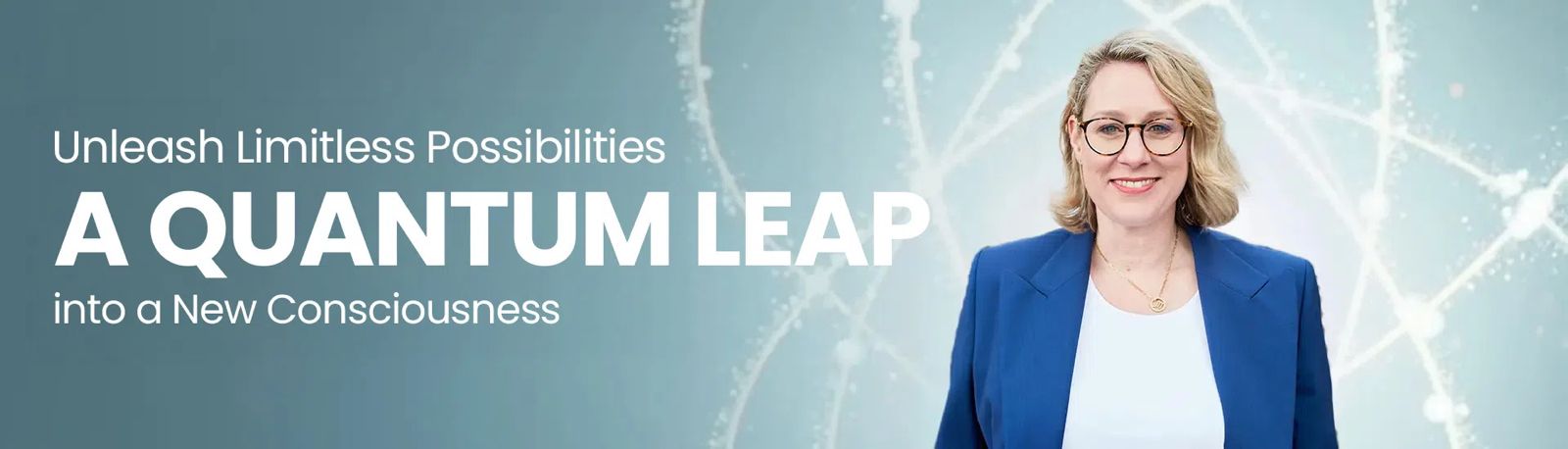
Quantum Entrepreneur and pioneer of Quantum Leadership
After 14 years of traditional leadership in the pharmaceutical industry, I discovered the quantum field as a revolutionary new dimension of leadership. Today, I teach leaders around the world how to apply quantum principles in practice.